

Pakistan Solar Adoption 2026
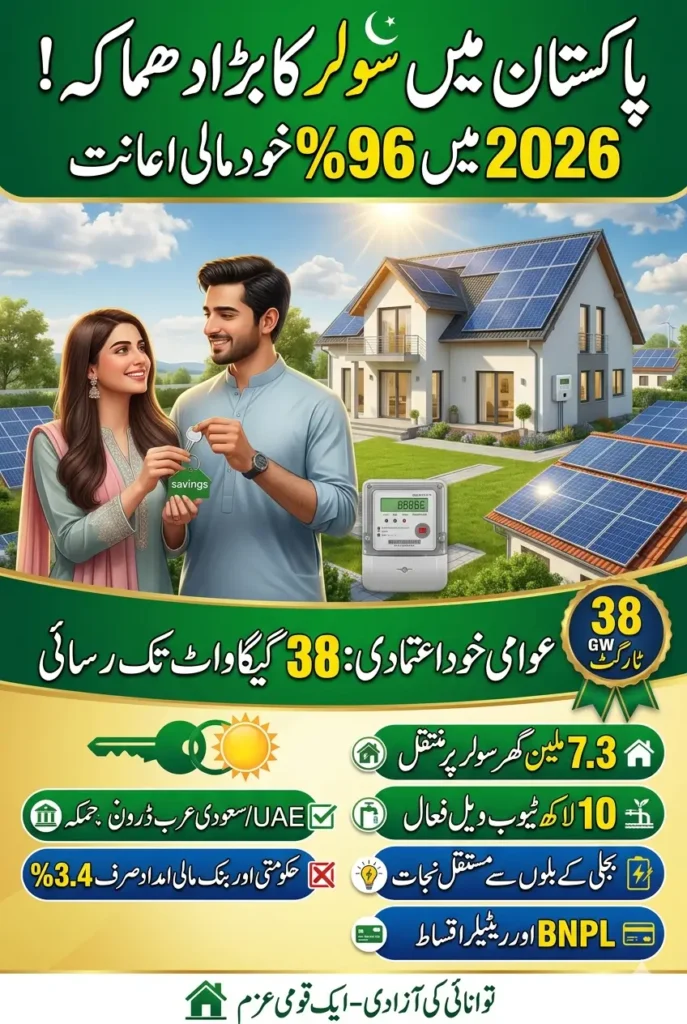
Pakistan’s solar sector has expanded quickly in recent years as more households and businesses switch to renewable energy. A recent study revealed that 96 percent of solar systems in Pakistan were self-financed by consumers instead of banks or government support. This trend highlights the growing public interest in affordable energy alternatives.
Govt Readies Next-Level Math to Increase Then Decrease Electricity Prices
Rising electricity tariffs and inflation have encouraged millions of people to install solar systems to reduce monthly expenses. As traditional electricity becomes more expensive, solar energy is becoming a cost-effective option for homes, farms, and industries. Many Pakistanis now consider solar a long-term investment for lower energy costs.
Limited Role of Banks in Solar Financing
Despite the fast expansion of solar energy, banks have contributed only a small portion of financing for solar projects. According to reports, formal loans represent only 3.4 percent of the estimated $14 billion investment made in distributed solar systems across Pakistan. Most consumers continue to depend on personal savings.
Experts believe that the main issue is not lack of demand but weak financing systems. Traditional bank loans often do not suit solar customers because repayment models are limited. Instead, many consumers rely on retailer installment plans and Buy Now Pay Later (BNPL) options to purchase solar equipment.
Pakistan’s Solar Capacity Reaches 38 GW
Pakistan’s distributed solar power capacity has reportedly reached around 38 gigawatts (GW) in FY25, showing rapid growth in renewable energy adoption. The report suggests that residential users are the biggest contributors, followed by industrial, agricultural, and commercial sectors. Solar systems are now becoming common across different parts of the country.
Out of the total installed capacity, around 21.3 GW operates behind the meter, while 9.7 GW is off-grid and 7.3 GW is net-metered. This data shows that people are increasingly producing electricity independently. The rising use of solar power is helping reduce dependence on expensive electricity sources.
Govt Praises Itself for Shielding Public From Costly Electricity During US-Iran War
Residential Sector Leading Solar Adoption
The residential sector remains the largest user of solar systems in Pakistan. Reports indicate that more than 7.3 million households have already installed solar panels to lower electricity bills and avoid load-shedding problems. Families are increasingly turning to solar because of rising power costs.
However, financing access in the residential sector remains extremely low at less than 1 percent. Most families continue using personal savings instead of bank loans to install systems. Retail credit providers have partly filled this gap by offering easier installment-based payment options.
Major Shift in Agricultural Solar Usage
Pakistan’s agriculture sector has also experienced major growth in solar energy use. Around 1 million tube wells have reportedly shifted to solar systems, reducing the farming sector’s reliance on diesel fuel. This transition has helped farmers lower operational expenses and improve efficiency.
Solar’s share in the tube well energy mix reportedly increased to 61 percent between 2022 and 2025. Previously, diesel costs represented a major portion of farming expenses for many growers. The move toward solar energy is helping reduce costs while improving long-term sustainability in agriculture.
Challenges in Industrial and Commercial Financing
The commercial and industrial sectors are also adopting solar systems, but financing remains uneven. Large industrial companies have easier access to formal financing because of stronger financial backgrounds. Smaller businesses, however, often struggle to secure affordable loans for solar installations.
Many small and medium-sized businesses continue depending on cash payments or retailer financing options. Experts warn that future growth in solar energy may slow if structured financing remains unavailable. Better financial products may be needed to help smaller businesses join the renewable energy shift.
Schools Directed to Remove Controversial O Level Book
Environmental Benefits of Solar Energy
Pakistan’s growing solar adoption is also helping reduce environmental pollution and carbon emissions. According to estimates, distributed solar systems prevented around 46 million tonnes of CO₂-equivalent emissions in FY25. This reduction may help Pakistan manage climate-related challenges more effectively.
The use of cleaner energy can also reduce Pakistan’s dependence on imported fuels and pressure on the national power grid. Solar energy supports environmental protection while helping consumers save money. These benefits make renewable energy an increasingly attractive choice.
Why Better Financing Is Important
Experts believe the next phase of Pakistan’s energy transition depends heavily on better financing systems. Most consumers who could afford solar independently have already invested in systems. Future growth may depend on helping lower-income households and smaller businesses access affordable financing.
Without proper financial support, many families and businesses may struggle to adopt solar despite strong demand. Policymakers may need to develop easier financing options to expand solar energy access nationwide. Better planning could help Pakistan continue its renewable energy progress.
FAQs
1. How much solar adoption in Pakistan is self-financed?
Around 96 percent of solar systems in Pakistan are funded directly by consumers.
2. Why are Pakistanis choosing solar energy?
High electricity bills and inflation have made solar energy a cheaper long-term option.
3. How many households use solar systems in Pakistan?
More than 7.3 million households have reportedly adopted solar systems.
4. What is Pakistan’s current solar capacity?
Pakistan’s distributed solar capacity has reached approximately 38 GW.
5. Why are banks not financing solar systems more?
Traditional loan systems often do not match the payment needs of solar consumers.
Oil Crosses $111 After Mysterious Drone Attacks on UAE and Saudi Arabia
Final Word
The rise of Pakistan Solar Adoption 2026 shows how consumers are taking energy solutions into their own hands despite limited financial support. Millions of households, farmers, and businesses are investing in solar systems to reduce electricity costs and improve energy independence. However, better financing options may still be necessary to make solar energy accessible for everyone in the future.