

Pakistan’s stock market demonstrated notable resilience during the third quarter of fiscal year 2025–26, even as global markets faced intense pressure due to geopolitical tensions, particularly the US-Iran conflict. According to the Securities and Exchange Commission of Pakistan (SECP), the Pakistan Stock Exchange (PSX) did not experience a market breakdown despite a visible decline in key indices.
New Survey Exposes Major Cybersecurity Issues in Pakistani Workplaces
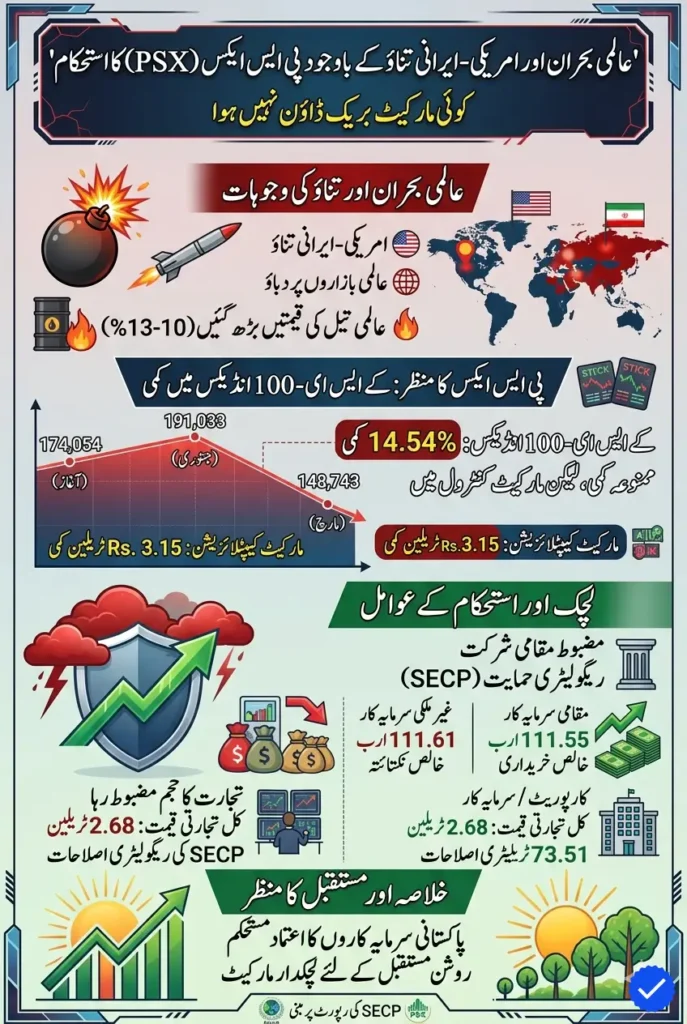
Globally, financial markets reacted sharply to rising uncertainty. Oil prices surged significantly, with Brent crude increasing by around 10 to 13 percent in the early phase of the conflict. Equity markets across major economies also declined, reflecting a broader risk-off sentiment among investors. However, despite these global shocks, Pakistan’s capital market managed to avoid panic selling and systemic instability.
KSE-100 Index Faces Volatility But Holds Ground
During the quarter, the benchmark KSE-100 index recorded a decline of 14.54 percent. It began the quarter at 174,054 points, reached a peak of 191,033 in January, and eventually closed at 148,743 by the end of March. The lowest point during the quarter was 144,119, reflecting a significant but controlled drop. This performance indicates that while the market faced pressure, it remained within manageable limits.
Other indices also followed a similar trend. The KSE All Share index declined by 14.85 percent, while the KSE-30 index fell by 15.52 percent. Monthly performance showed fluctuations, with January witnessing growth of 5.81 percent, followed by declines of 3.75 percent in February and 11.50 percent in March. These movements reflect the impact of both external pressures and internal market adjustments.
Market Capitalization and Trading Activity
Market capitalization saw a decline of Rs. 3.15 trillion, dropping from Rs. 19.69 trillion to Rs. 16.53 trillion during the quarter. Despite this reduction, trading activity remained strong, indicating continued investor interest and confidence in the market. Total traded volume reached 48.8 billion shares, while the total traded value stood at Rs. 2.68 trillion.
On average, daily trading volume was recorded at 791.7 million shares, with a daily traded value of Rs. 44.03 billion. Around 485 companies remained actively traded in each session, reflecting broad-based participation across the market. This sustained activity suggests that investors remained engaged despite volatility.
Karachi Kings Keep Playoff Hopes Alive with Stunning Win
Role of Domestic and Foreign Investors
One of the key highlights of the SECP report is the role of domestic investors in maintaining market stability. Foreign investors recorded net outflows of Rs. 111.61 billion, largely driven by global uncertainty and risk aversion. However, domestic investors stepped in to absorb this selling pressure, contributing net purchases of Rs. 111.55 billion.
Corporate investors led the way with net buying of Rs. 73.51 billion, followed by mutual funds and individual investors. This strong domestic participation played a critical role in preventing a deeper market decline and ensured liquidity remained intact throughout the quarter.
Sector Performance and Key Stocks
Trading activity remained concentrated in blue-chip stocks, which continued to attract investor attention. National Bank of Pakistan emerged as the most actively traded stock in terms of value, followed by major companies such as Pakistan Petroleum, OGDC, Fauji Fertilizer, and Habib Bank. These companies are considered stable and reliable, making them attractive during periods of uncertainty.
In terms of volume, K-Electric led the market with the highest number of shares traded, followed by Bank of Punjab and World Call Telecom. The continued interest in these stocks highlights the diversity of investor preferences and the overall depth of the market.
PM Shahbaz Orders Fast-Track Local Battery Production for EVs and Solar
Primary and Debt Market Activity
The primary market remained active during the quarter, with the SECP approving three initial public offerings. This indicates that companies are still willing to raise capital despite market volatility. The debt market also showed strong performance, particularly in government-backed instruments.
Three auctions of Government of Pakistan Ijara Sukuk were conducted with a target of Rs. 800 billion. The response from investors was strong, with total bids reaching Rs. 2.03 trillion, resulting in a bid-to-cover ratio of 2.54 times. The government accepted Rs. 811.53 billion, reflecting robust demand for low-risk investment options.
Secondary market activity in debt instruments also remained healthy, with significant trading volumes recorded in Ijara Sukuk, treasury bills, and bonds. Additionally, two privately placed corporate sukuk were listed, further expanding investment opportunities.
Regulatory Reforms and Market Confidence
The SECP emphasized the importance of ongoing regulatory reforms in maintaining market stability. These reforms aim to improve transparency, enhance investor protection, and strengthen the overall financial system. By implementing effective policies and monitoring mechanisms, the regulator has been able to support the market during turbulent times.
The report concludes that despite facing significant external challenges, Pakistan’s capital market has shown resilience and adaptability. The combination of strong domestic participation, active trading, and supportive regulatory measures has helped maintain investor confidence.
Govt Orders Probe Into Costly Off-Grid Power Purchases by Discos
FAQs
What was the main reason behind the PSX decline?
The decline was mainly due to global geopolitical tensions, rising oil prices, and a broader risk-off sentiment.
How much did the KSE-100 index fall during the quarter?
The KSE-100 index declined by 14.54 percent.
Did foreign investors contribute positively to the market?
No, foreign investors recorded net outflows during the quarter.
Who supported the market during foreign selling?
Domestic investors, including corporates and mutual funds, absorbed the selling pressure.
Was trading activity affected during the decline?
No, trading activity remained strong with high volumes and active participation.
Revised PTA Tax Values for Used iPhone 15 Series in Pakistan
Final Words
The performance of Pakistan’s stock market during this challenging period reflects its growing maturity and resilience. While global uncertainties continue to pose risks, the ability of domestic investors and regulators to maintain stability is a positive sign for the future. Continued reforms, investor confidence, and balanced participation will be key to sustaining growth and navigating future market challenges.