

Govt Websites in Pakistan Locked Down
Pakistan’s National Cyber Emergency Response Team (CERT) has ordered all federal and provincial government websites to switch to “Read-Only” mode because of increasing cyber threats and regional tensions. The step was taken to protect official websites from hackers who may try to damage systems, steal data, or spread fake information online. Authorities believe this temporary measure can help secure important digital platforms during a sensitive period.
Punjab to Establish First Provincial General Insurance Company
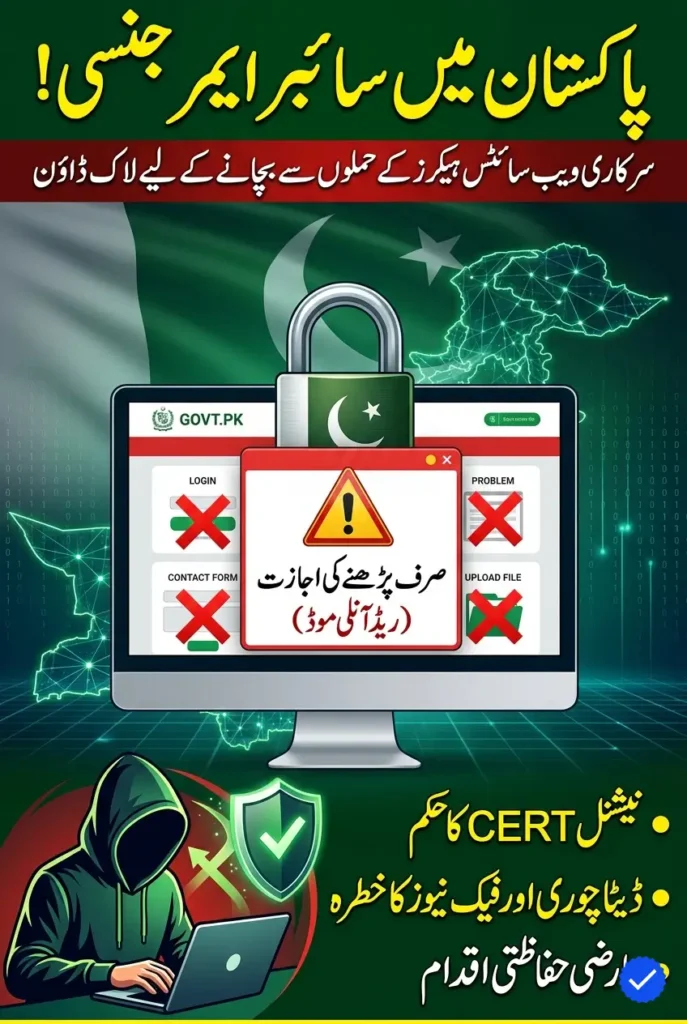
Under the new instructions, government departments have been told to disable all interactive features such as login portals, contact forms, search bars, and file upload systems. Cybersecurity experts say these features can become weak points for attackers trying to enter government networks. By limiting website activity, officials hope to reduce the risk of unauthorized access and cyberattacks.
Main Cybersecurity Risks
CERT warned that hackers may attempt website defacement attacks, where webpage content is changed to display propaganda or false news. Such attacks are often used to create confusion and damage public trust. Government websites are common targets because they represent official state communication.
The agency also highlighted the danger of SQL injection attacks, which allow hackers to access sensitive databases through vulnerable website forms or search functions. If successful, attackers could steal citizen information or gain control over backend systems. Disabling these functions is expected to lower these risks significantly.
Protection Measures Introduced
The advisory recommended several technical steps to strengthen security. Government institutions have been asked to block all modification requests, remove database write permissions, and allow backend access only to authorized staff through strict IP controls. Officials were also advised to monitor website logs for suspicious activities.
CERT further recommended the use of Content Delivery Networks (CDNs) to handle sudden traffic spikes caused by Denial of Service (DoS) attacks. Offline backups and static copies of websites should also be kept ready so that services can be restored quickly in case of a cyber breach.
Power Division Introduces QR Code System to Show Electricity Subsidy
Growing Threat from Hackers
According to CERT, the threats may come from both state-sponsored Advanced Persistent Threat (APT) groups and hacktivists with political or ideological motives. These groups may try to infiltrate systems for long-term spying or attack websites simply to gain attention.
The advisory noted that outdated plugins, themes, and weak passwords in content management systems (CMS) can also make websites vulnerable. Government agencies have therefore been instructed to update security systems and strengthen administrative controls immediately.
FAQs
1. Why did Pakistan shift government websites to “Read-Only” mode?
The government took this step to protect official websites from cyberattacks, hacking attempts, and online misinformation campaigns.
2. What is “Read-Only” mode?
“Read-Only” mode means visitors can view website content, but interactive functions like forms, uploads, and logins are disabled.
3. What cyber threats were mentioned by CERT?
CERT warned about website defacement, SQL injection attacks, Denial of Service (DoS) attacks, and unauthorized system access.
4. Who could be behind these cyber threats?
The threats may come from hacktivists or state-sponsored Advanced Persistent Threat (APT) groups.
5. What security measures were recommended?
CERT advised departments to disable interactive features, use offline backups, monitor activity logs, and strengthen backend access controls.
Final Word
Pakistan’s decision to place government websites in “Read-Only” mode shows how serious cyber threats have become in the digital age. Authorities are trying to prevent attacks before they happen and protect important public systems from disruption. Experts believe strong cybersecurity measures and continuous monitoring are necessary to keep national digital infrastructure safe from evolving online threats