
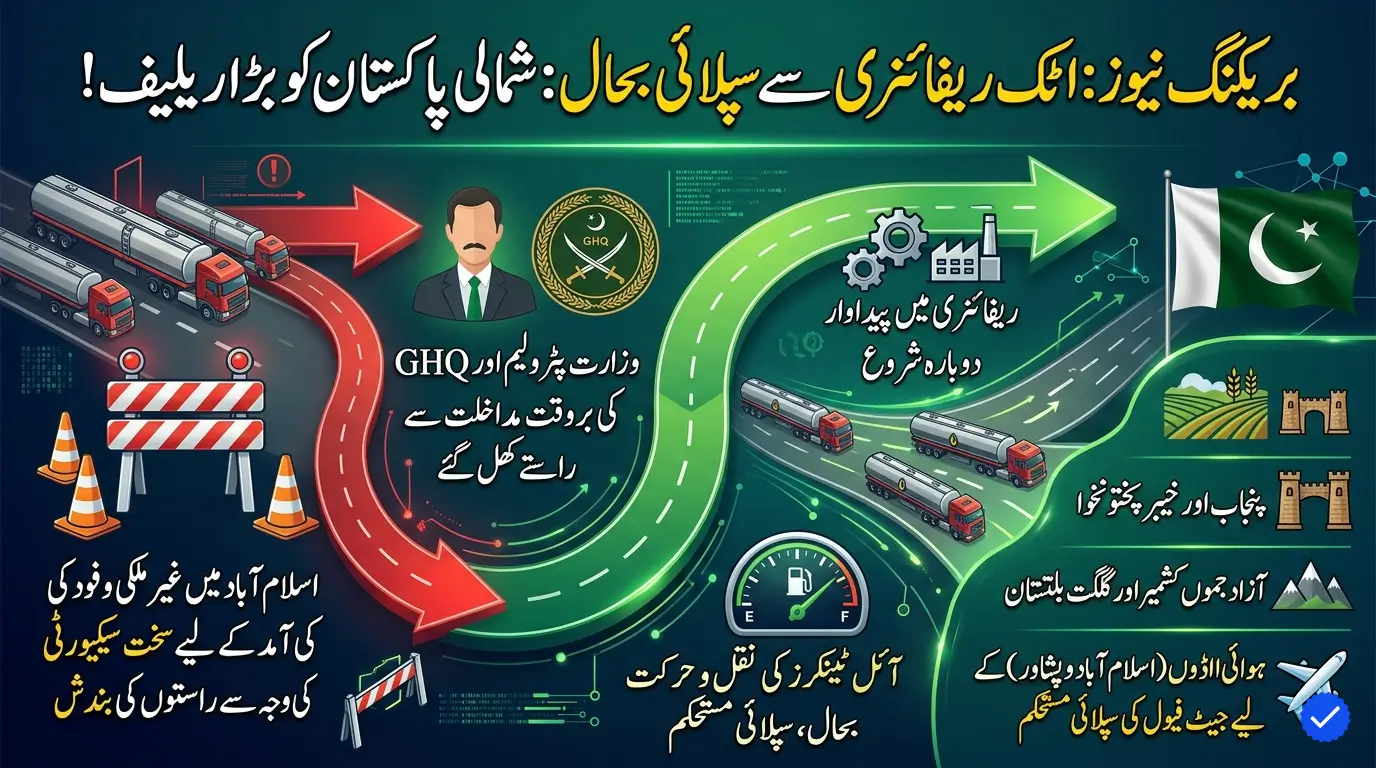
Fuel supply from Attock Oil Refinery has resumed after authorities restored the movement of oil tankers, easing concerns over shortages in northern Pakistan. The development comes as a relief for both consumers and businesses that rely heavily on a steady supply of petroleum products.
PM Shahbaz Orders Fast-Track Local Battery Production for EVs and Solar

The refinery had earlier shut down its main crude distillation unit after road closures disrupted the transportation of crude oil and refined products. These restrictions were imposed due to the expected arrival of foreign delegates in Islamabad, leading to strict security measures and the suspension of tanker movement for several days.
Government Intervention Restores Operations
The situation improved after timely intervention by Petroleum Minister Ali Pervaiz Malik, along with support from the General Headquarters (GHQ). Authorities worked to ensure that blocked routes were reopened and tanker movement could resume without further delay.
Refinery management confirmed that road access was restored late at night, allowing oil tankers to move in and out of the facility. As a result, the refinery has started gradually resuming its operations. Officials stated that while production has restarted, it may take a short period before full capacity is achieved.
Impact of the Shutdown
The temporary shutdown had a significant impact on fuel supply chains. Attock Refinery, which plays a key role in supplying fuel to northern regions, was unable to receive crude oil or dispatch refined products during the disruption.
The refinery’s main unit, with a capacity of 32,400 barrels per day, remained non-operational, raising serious concerns about fuel availability. Regions including central and northern Punjab, Khyber Pakhtunkhwa, Azad Jammu and Kashmir, and Gilgit Baltistan were particularly vulnerable to potential shortages.
Due to dispatch constraints, large quantities of Motor Spirit (petrol) and High-Speed Diesel accumulated at the refinery. At the same time, crude oil supplies declined sharply because incoming shipments could not reach the facility. This imbalance forced the refinery to halt operations completely.
Govt Orders Probe Into Costly Off-Grid Power Purchases by Discos
Supply Chain Challenges and Economic Concerns
The disruption highlighted the fragile nature of Pakistan’s fuel supply chain, which heavily depends on smooth transportation logistics. Any interruption in tanker movement can quickly create bottlenecks, affecting both supply and production.
Businesses, transporters, and industrial sectors closely monitored the situation, as prolonged disruption could have increased fuel prices and created operational difficulties. Public transport services, logistics companies, and agricultural activities are especially sensitive to fuel supply issues.
Experts believe that such incidents underline the need for better contingency planning and infrastructure development. Ensuring alternative routes and improving storage capacity could help mitigate similar risks in the future.
Risk of Fuel Shortages
Officials had warned that if the restrictions continued for a longer period, the country could face serious fuel shortages. One of the most critical concerns was the potential shortage of jet fuel at Islamabad and Peshawar airports.
Aviation operations rely on a continuous supply of jet fuel, and any disruption can affect flight schedules and airport operations. Fortunately, the timely restoration of tanker movement prevented the situation from escalating further.
Additionally, petrol pumps in several areas had started reporting concerns over limited supplies, which could have led to panic buying if the issue had persisted.
Revised PTA Tax Values for Used iPhone 15 Series in Pakistan
Strategic Importance of Attock Refinery
Attock Refinery Limited (ARL) is one of Pakistan’s oldest and most important refineries. It plays a crucial role in ensuring the supply of petroleum products across multiple regions.
Its strategic location and distribution network make it a key component of the country’s energy infrastructure. Any disruption in its operations can have a widespread impact, especially in areas that rely heavily on its supply.
The recent shutdown once again demonstrated how essential it is to keep such facilities running smoothly and to protect supply chains from unexpected disruptions.
Situation Returning to Normal
With the lifting of road restrictions, the immediate risk of fuel shortages has been significantly reduced. Tanker movement has resumed, and the refinery is steadily increasing its production levels.
Officials are optimistic that normal operations will be fully restored soon. Fuel supply to affected regions is also expected to stabilize in the coming days, easing concerns among consumers and businesses.
Authorities are likely to review the situation and take preventive measures to avoid similar disruptions in the future. Improved coordination between security agencies and the energy sector could play a vital role in this regard.
Bank Alfalah Rs. 20 Billion Long Term Funding Plan A Detailed Overview
Frequently Asked Questions (FAQs)
1. Why was Attock Refinery shut down?
The refinery was shut down because road closures blocked the transportation of crude oil and refined petroleum products, making it impossible to continue operations.
2. What caused the road closures?
The closures were implemented as part of security arrangements for the arrival of foreign delegates in Islamabad.
3. Which regions were at risk of fuel shortages?
Central and northern Punjab, Khyber Pakhtunkhwa, Azad Jammu and Kashmir, and Gilgit Baltistan were most at risk.
4. What is the production capacity of Attock Refinery?
The refinery’s main crude distillation unit has a capacity of approximately 32,400 barrels per day.
5. Has the situation been fully resolved?
Yes, tanker movement has resumed, and the refinery is gradually returning to full operational capacity, with supply conditions improving.
FBR Reduces Property Valuation Rates in Five Cities of Punjab
Final Words
The temporary shutdown of Attock Refinery highlights how sensitive Pakistan’s fuel supply system is to logistical disruptions. Even short-term road closures can trigger widespread concerns, affecting multiple provinces and critical sectors like transportation and aviation. However, the swift response from government authorities and security institutions helped contain the situation before it escalated into a full-scale fuel crisis.